India’s dairy industry has long been recognized as one of the country’s greatest success stories. The White Revolution transformed India from a milk-deficient nation into the world’s largest milk producer. Today, the industry contributes nearly a quarter of global milk production and supports the livelihoods of millions of dairy farmers across the country. However, the next phase of growth will not be driven by production alone—it will be driven by data, automation, traceability, and intelligent decision-making. This is where digital transformation is reshaping the future of India’s dairy sector.
Why Digitalization Matters
Dairy industry technology in India operates at an extraordinary scale. As the world’s largest milk producer, the country produces more than 250 million tonnes of milk annually, sourced from millions of smallholder farmers spread across thousands of villages.
Managing milk procurement, quality testing, farmer payments, animal health records, processing operations, and distribution networks at this scale is nearly impossible through manual processes alone. As dairy businesses continue to grow, traditional systems often struggle to provide the speed, accuracy, and transparency required for efficient operations.
Digital technologies are helping bridge this gap by enabling real-time data capture, automated processes, improved traceability, and faster decision-making across the dairy value chain. For dairy organizations looking to improve efficiency, maintain quality standards, and strengthen farmer engagement, digitalization is no longer an option—it has become a necessity.
Why the Dairy Industry Technology Needs Digital Transformation
For decades, dairy operations relied heavily on manual processes. Milk procurement records were maintained on paper, quality testing was often decentralized, farm-level data was limited, and decision-making depended largely on experience rather than real-time insights.
As the dairy ecosystem expanded, these traditional methods began creating challenges such as:
- Lack of transparency in milk procurement
- Delays in farmer payments
- Inconsistent milk quality
- Limited traceability across the supply chain
- High operational costs
- Inefficient logistics and distribution
- Difficulty in managing large volumes of farmer and livestock data
- Limited visibility into animal health and productivity
With millions of farmers, thousands of collection centres, and highly perishable products moving through the supply chain every day, the dairy industry technology requires accurate and real-time information at every stage. Digital technologies make this possible.
The Four Stages of Digital Transformation in Dairy
Digital transformation in the dairy industry is not a single technology implementation. It is a progressive journey that connects every stage of the dairy value chain through data, automation, and intelligent decision-making.
Stage 1: Digitizing Milk Procurement
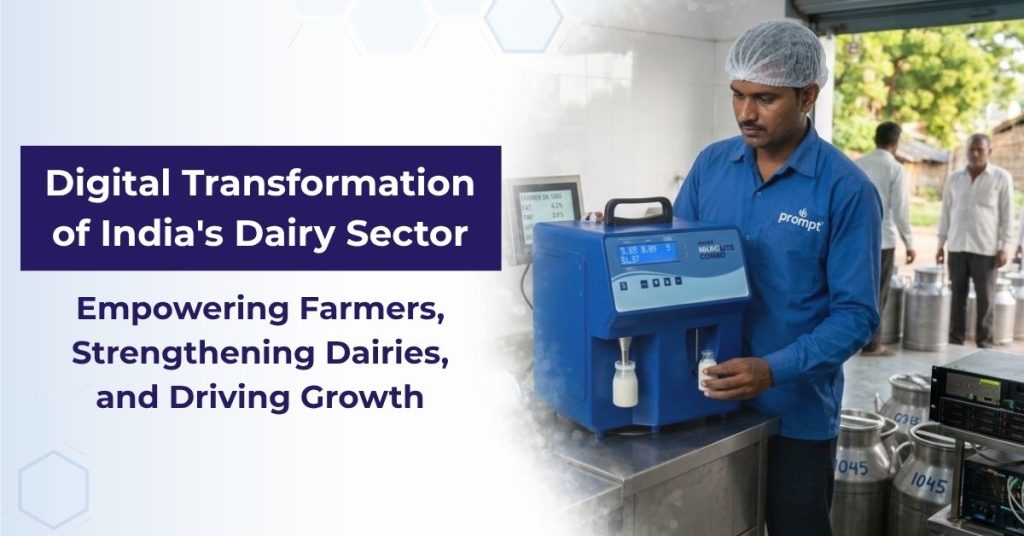
The first stage of dairy digitalization focuses on automating milk collection and procurement processes. Technologies such as digital weighing systems, Automatic Milk Collection Systems (AMCS), smart milk analyzers, and integrated farmer payment solutions help improve transparency, reduce manual errors, and build trust between farmers and dairy organizations.
Stage 2: Connecting Dairy Farms
The next stage involves digitizing farm-level operations. Animal identification systems, breeding records, vaccination tracking, health monitoring, feed management, and farm productivity tools enable farmers to make better decisions and improve herd performance through data-driven management.
Stage 3: Smart Dairy Operations
As dairies scale their operations, technology plays a critical role in improving plant efficiency. Dairy ERP systems, automated processing equipment, production planning tools, quality management systems, and real-time monitoring platforms help dairy businesses optimize resources, reduce losses, and maintain consistent product quality.
Stage 4: Connected Dairy Ecosystems
The most advanced stage of digital transformation connects farmers, milk collection centres, processing plants, logistics networks, distributors, and consumers into a unified ecosystem. Technologies such as IoT-enabled monitoring, cloud platforms, predictive analytics, artificial intelligence in dairy industry, and end-to-end traceability systems provide complete visibility across the dairy value chain, enabling faster decisions and greater operational efficiency.
As the industry evolves, dairy organizations are increasingly moving beyond isolated technology deployments and building fully connected digital ecosystems that improve productivity, transparency, and sustainability across every stage of operations.
Key Challenges Facing Dairy Digitalization
While the benefits of digital transformation are clear, implementing technology across a highly fragmented and diverse dairy ecosystem comes with its own set of challenges.
Fragmented Dairy Ecosystem: India’s dairy industry is dominated by smallholder farmers. Implementing technology across millions of farms requires scalable and user-friendly solutions.
Data Standardization: Collecting reliable data from farms, collection centres, chilling facilities, and processing plants remains a challenge.
Technology Adoption: Many farmers and rural operators require training and support to fully utilize digital tools and systems.
Infrastructure Limitations: Connectivity, power availability, and digital literacy continue to vary across different regions.
Integration Across the Value Chain: The greatest value of digitalization is achieved when farm, procurement, quality, processing, and distribution systems are connected. Achieving this integration remains an ongoing journey for many dairy organizations.
The Impact of Digital Transformation
When implemented effectively, digital transformation creates measurable benefits across the dairy ecosystem.
For Farmers
- Transparent milk procurement
- Faster and more accurate payments
- Improved herd management
- Better animal health monitoring
- Increased productivity
For Dairy Cooperatives and Processors
- Improved operational efficiency
- Better quality control
- Reduced manual errors
- Enhanced traceability
- Faster decision-making
For Consumers
- Improved food safety
- Greater product traceability
- Higher quality dairy products
- Increased confidence in the dairy supply chain
The result is a smarter, more transparent, and farmer-centric dairy ecosystem that benefits every stakeholder.
PromptDairyTech’s Role in India’s Digital Dairy Journey
Digital transformation in India’s dairy industry did not happen overnight. It has been the result of continuous innovation across milk procurement, quality testing, farm management, cold chain infrastructure, and data management.
Prompt DairyTech has been part of this journey for over three decades.
From village-level milk collection centres to large dairy enterprises, Prompt’s technologies have helped digitize critical dairy operations across procurement, quality assurance, farm management, and supply chain monitoring.
When milk collection in many villages was still dependent on manual record keeping, delayed calculations, and paper-based operations, Prompt Dairytech introduced technologies that helped dairies automate milk procurement and improve transparency at the farmer level.
The introduction of Automatic Milk Collection Systems (AMCS) in the 2015 helped digitize one of the most critical touchpoints in the dairy value chain—milk procurement. By automating milk measurement, quality testing, and payment calculations, dairies could improve accuracy while farmers benefited from greater transparency and trust.
Since then, PromptDairyTech has continued to develop technologies that support digital transformation across the dairy ecosystem, including:
- Milk collection automation
- Quality testing solutions
- Farm digitization
- Milk chilling infrastructure
- Supply chain visibility
- Traceability systems
- Cloud-connected dairy platforms
- IoT-enabled monitoring solutions
Today, as the industry embraces data-driven decision-making, Prompt continues to support dairy cooperatives, private dairies, and farmers in building a more connected and efficient dairy ecosystem.
The Future of Dairy Is Digital
The future of India’s dairy industry technology will be driven not just by higher milk production, but by smarter farms, connected supply chains, real-time quality monitoring, and data-driven decision-making. Technologies such as AI, IoT, cloud platforms, predictive analytics, and digital livestock management are helping dairies improve productivity, efficiency, and sustainability.
Just as the White Revolution transformed milk production, digital transformation is powering the next phase of growth—creating a more transparent, efficient, and farmer-centric dairy ecosystem. For over 30 years, Prompt Dairytech has been contributing to this evolution by developing technologies that help dairies and farmers embrace a smarter, more connected future.
FAQs
1. What is digital transformation in the dairy industry?
Digital transformation refers to the use of technologies such as automation, IoT, cloud platforms, analytics, and digital records to improve efficiency, transparency, and decision-making across the dairy value chain.
2. How does digital transformation benefit dairy farmers?
It helps improve transparency, herd management, milk quality, productivity, and payment accuracy while reducing manual work.
3. What technologies are used in modern dairy farming?
Common technologies include milk analyzers, automated milk collection systems, livestock management software, IoT sensors, cloud platforms, AI-based analytics, and traceability systems.
4. Why is digitalization important for dairy cooperatives?
Digitalization helps cooperatives improve procurement efficiency, quality control, farmer engagement, operational visibility, and data-driven decision-making.
5. How has PromptDairyTech contributed to dairy digitalization in India?
For over 30 years, Prompt Dairytech has developed technologies for milk procurement automation, quality testing, farm digitization, supply chain monitoring, and traceability solutions that support India’s evolving dairy ecosystem.