Dairy farming is evolving fast.
As the world’s largest dairy producer, India has over 300 million cattle producing several litres of milk every day. However, maintaining production at this scale, especially in large dairy farms, demands not just robust herd management, but also data-driven operations. With the advent of smart devices and IoT in dairy farming, milk producers are adopting advanced techniques to monitor herd health, track breeding cycles, and optimize feeding practices, paving the way for farm expansion and increased milk production.
What is IoT in Dairy Farming?
Internet of Things (IoT) primarily refers to a network of physical devices connected to the internet that can collect and exchange data. Modern dairy farms often use several pieces of equipment that monitor cattle health, milk production, milk quality, feeding and water consumption, reproductive cycles, etc. These systems then track and analyze patterns, turn them into insights, and help farmers make informed decisions.
Unlike traditional farming methods that rely heavily on observation and manual record-keeping, IoT in farming provides continuous monitoring and automated alerts, allowing farmers to identify potential issues before they become major problems.
Traditional Dairy Farming v/s IoT-based Smart Dairy Farming
| Aspect | Traditional Farming | IoT-based Smart Farming |
| Herd Monitoring | Depends on manual observation and periodic checks. | Continuous real-time monitoring, a few clicks away. |
| Heat Detection | Visual detection only, often missed. | The right equipment could send alerts the moment cattle go into heat. |
| Health Management | Diseases are detected only by visible symptoms. | Early warning signs help identify potential issues before they arise. |
| Breeding Efficiency | Relies on manual timing of insemination. | Higher heat detection accuracy increases the chances of insemination. |
| Scalability | Difficult to manage as the herd expands. | Monitoring systems can scale with herd size. |
Key Applications of IoT in Dairy Farming
Farmers can harness several key applications of IoT technology in their daily activities to raise healthy cattle sustainably.
Cattle Health Monitoring:
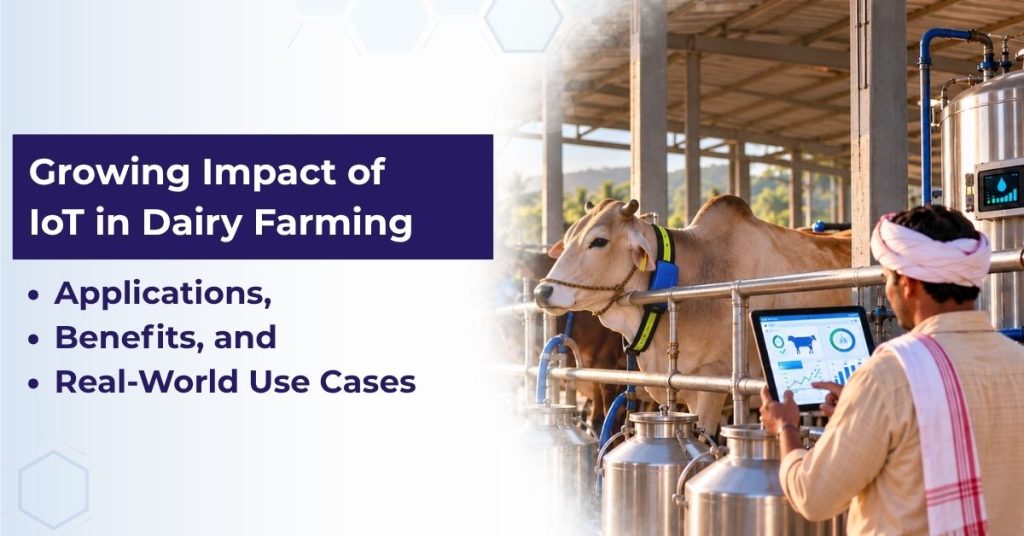
Wearable sensors can help track activity levels, heart rate, body temperature, and so on. These devices help farmers monitor these parameters in real time, so they can detect abnormalities early if these parameters change.
GeoFencing
Large dairy farms can find it difficult to monitor cattle movement during grazing. IoT in farming includesr GeoFencing, where farmers can monitor the location of their cattle and set virtual boundaries.
Heat Detection and Reproductive Management
Detecting the cattle’s heat period is critical for a successful breeding cycle and herd management. On average, this can last anywhere between 12- 24 hours, making the viable period quite short and easy to miss. Here, smart IoT-based devices help by sending alerts to farmers when cattle go into heat, so they can make informed decisions on breeding accordingly.
Milk Production Monitoring
Connected dairy systems can track milk yield, milking frequency, and production trends in real time. By analyzing this information, farmers can identify high-performing animals and make informed decisions about nutrition, health management, and herd performance.
Environmental Monitoring
Milk production depends on several factors, including the environment that the cattle reside in. By placing sensors across their farms, farmers can monitor temperatures, humidity, air quality, and more.
Feed and Water Management
Smart IoT-based devices can also help farmers track cattle feeding patterns, which influence nutritional and dietary needs. Automated feeders can then provide feed tailored to the cattle’s specific requirements.
Benefits of Smart Farming using IoT
IoT in farming is beneficial mainly because it provides data-driven visibility. Farmers can make informed decisions based not only on what is visible but also on insights they gain from data. This shift can transform dairy farms by boosting milk production and improving herd management.
Improved Herd Health: Early disease detection enables early intervention, saving time and resources and enhancing well-being.
Better Breeding Performance: Timely detection of heat periods helps farmers time insemination, improving conception rates and reducing the financial impact of missed breeding opportunities.
Higher Productivity: A well-managed herd in a well-kempt environment, receiving nutrition suited to their needs, is bound to produce more milk.
Real-world Use Case: Prompt BovSmart
One of the real-world examples of a wearable IoT device is Prompt BovSmart – a cattle heat detection solution that offers a complete overview of cattle activity. It is a comfortable, non-invasive collar with sensors that detect various changes in cattle.
IoT in dairy farming is meant to give farmers insights based on the data it gathers. Prompt BovSmart detects the onset of the cow’s heat cycle with 90% proven accuracy, helping farmers identify optimal breeding windows. This reduces missed heat events, improves insemination timing, and supports better reproductive performance across the herd.
It is easily accessible through a mobile application and provides alerts during heat and health concerns. It also offers Geofencing, location tracking, and rumination monitoring, helping farmers monitor where their herd is and its well-being.
The Future of Smart Dairy Farm Technology
The future of dairy farm technology will be increasingly connected, automated, and intelligent. As more data becomes available through connected devices, farms will be able to anticipate issues before they occur, optimize resource utilization, and improve overall operational efficiency. The combination of artificial intelligence and IoT is expected to accelerate the transition toward highly efficient, sustainable, and resilient dairy farming systems.
Looking to improve breeding and make more informed herd management decisions? Connect with our experts.
Frequently Asked Questions (FAQs)
1. What is IoT in dairy farming?
IoT in dairy farming refers to the use of connected sensors, wearable devices, software platforms, and analytics tools that monitor animals, equipment, and farm operations in real time. These systems help farmers improve productivity, animal health, and decision-making.
2. How does smart livestock monitoring work?
Smart livestock monitoring uses sensors and wearable devices to track activity, movement, health indicators, and behavioral patterns. The collected data is analyzed to identify potential health or reproductive events and provide actionable alerts to farmers.
3. What is heat detection technology in dairy farming?
Heat detection technology uses behavioral and activity data to identify when a cow enters its reproductive cycle. This helps farmers determine the optimal time for breeding and improves conception rates.
4. Can IoT help reduce dairy farm operating costs?
Yes. IoT systems automate data collection, reduce labor-intensive monitoring tasks, improve resource utilization, and enable earlier intervention for health and reproductive issues. This can lower veterinary expenses, improve breeding outcomes, and reduce operational inefficiencies.
5. Is IoT technology suitable for small and medium-sized dairy farms?
Yes. Many IoT solutions are scalable and can be implemented across farms of different sizes.
6. How does IoT improve breeding management in dairy farming?
IoT-enabled wearable sensors continuously monitor cattle activity and behavioral patterns.