
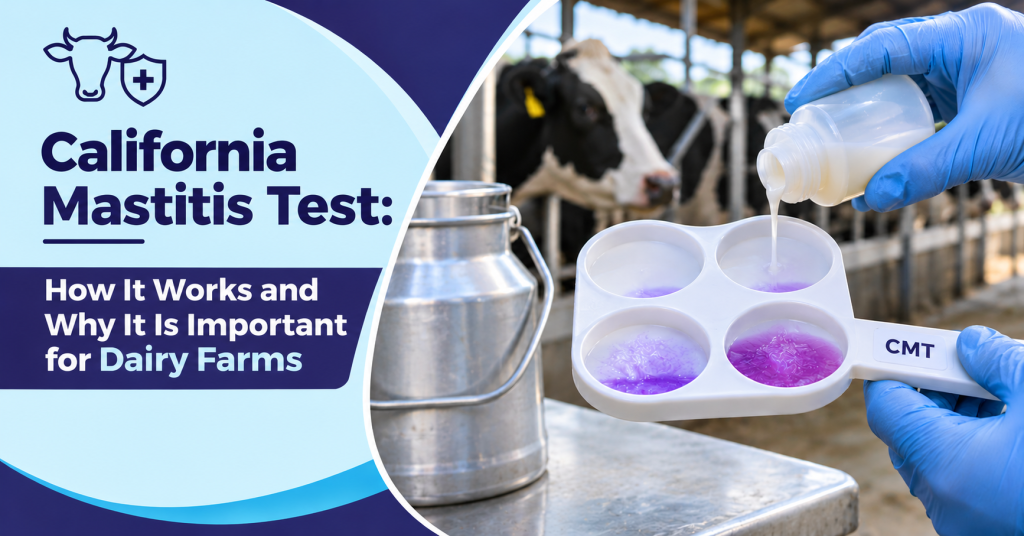
One of the most common diseases that has severely impacted dairy farmers, the health of their herd, and their profits and productivity is mastitis. This condition causes an inflammation of the udder and mammary glands, but is not easily detected through visible symptoms alone. That’s why farmers are recommended to use a reliable California Mastitis Test (CMT) kit to detect the disease early.
Role of the California Mastitis Test (CMT) kit in Mastitis Detection
Mastitis can be categorized into two types – clinical and subclinical. The former comes with typical signs and symptoms, including red, swollen teats; tenderness; and watery milk with clots and flakes. The latter, however, has no visible symptoms and only shows up on diagnostic tests. Undetected subclinical mastitis significantly impacts milk quality and yield and can even spread within the herd. It can silently reduce milk yield and result in higher treatment costs, making early detection an important part of dairy farm management.
This is where CMT kits come in. A CMT kit is a quick and easy way to detect mastitis early, so farmers can begin appropriate care for their cattle.
It is portable, so farmers can carry it to their fields, and it doesn’t require specialized knowledge to conduct a successful test. All it takes is a few samples of milk directly from the cow in order to run the test.
How to use a CMT kit?
Reliable CMT kits like the Prompt BovEasy CMT kit require farmers to follow a few simple steps to detect mastitis in their cows.
Step 1: Strip some milk into the paddles provided in the kit. Make sure they have been thoroughly sanitized prior to the test.
Step 2: Measure the recommended amount of reagent for the test. For kits like the Prompt BovEasy CMT kit, the recommended amount is 3ml in each cup for 3ml of milk.
Step 3: Pour the reagent into each cup and swirl around gently for about 10 seconds.
Step 4: Wait for a few seconds to check for any changes.
Ideally, the solution should be able to show results within 20 seconds. If there is any change in the consistency of the liquid, it indicates the presence of mastitis. However, if there is no change, then the cow probably does not have the infection. Farmers can follow the appropriate protocol accordingly.
The Science behind Reliable CMT kits
Mastitis is often linked to Somatic Cell Count (SCC), which is a measurement of the white blood cells mixed with discarded udder cells. They serve as an indicator of udder and teat health, especially during medical conditions.
Incidentally, SCC levels are also observed to check the quality of a given milk sample. In both cases, a higher level of SCC means bad news – it indicates an infection in the udder and a shortfall of lactose and casein.
CMT kits test for the presence of higher amounts of SCC. The reagent consists of a detergent with a pH indicator that reacts with the outer and nuclear cell walls of any white blood cell. These will then form a gel-like structure that spreads as the SCCs increase.
Why Regular CMT Testing Matters for Dairy Farms
Every Indian dairy farm is different, with varying numbers of cows and fluctuating amounts of milk being produced. But one common goal across these fragmented farms is to ensure that cows remain in good health and that their yield is enhanced.
CMT kits play a crucial role in fulfilling this goal. Mastitis often poses a silent threat, impacting herd health and milk yield on several dairy farms. Solutions like CMT kits can help detect mastitis early, thwarting its spread before it gets too late.
Preventative care could reduce the chances of mastitis. Keeping the surroundings clean, sanitizing the cattle’s stalls, barns, sheds, etc., and using a post-milking teat dip solution to protect the teat from bacteria could significantly reduce the chances of mastitis.
However, early detection using reliable CMT kits like the Prompt BovEasy CMT kit allows quick intervention and a shorter recovery period. Many dairy farms perform periodic herd screening to identify infections before symptoms become visible. With timely treatment, farmers can isolate the affected animal and curb the disease’s spread.
Curious to know how the Prompt BovEasy CMT kit can enhance the productivity of your dairy farm? Schedule a call with us today.
FAQs
1. How does a CMT kit detect mastitis?
A CMT kit uses a reagent that reacts with somatic cells present in milk. Higher SCCs transform the sample into a gel-like substance, indicating the possible presence of mastitis.
2. Can a CMT kit detect subclinical mastitis?
Yes. California Mastitis Test kits like the Prompt BovEasy CMT kit are commonly used to identify subclinical mastitis, which often shows no visible signs in the cow or the milk.
3. How often should dairy farmers use a California Mastitis Test kit?
Many farms include regular, monthly CMT screening as part of their herd health management program.
4. Why is subclinical mastitis difficult to detect?
Subclinical mastitis does not usually cause visible changes in the udder or milk, making diagnostic tools such as SCC testing and CMT kits essential for early detection.
5. How long does a California Mastitis Test kit take to work?
Most CMT kits, like the Prompt BovEasy CMT kit, provide results within 15-20 seconds after the reagent is mixed with the milk sample.