India is the world’s largest milk producer, but one of the biggest challenges facing the dairy industry is the shortage of quality green fodder. While milk production continues to grow, the availability of nutritious fodder has not kept pace. Limited land for fodder cultivation, water scarcity, unpredictable weather, and rising feed costs have made it increasingly difficult for dairy farmers to provide balanced nutrition to their cattle. According to industry estimates, India faces a green fodder deficit of 11–35%, while feed accounts for nearly 72–75% of the total cost of milk production.
For progressive dairy farmers, breeding centres, gaushalas, and commercial dairy farms, fodder availability directly affects cattle health, milk production, and overall farm profitability. This has created a growing need for year-round fodder production systems that are independent of seasonal conditions.
Unlike conventional cultivation that typically takes 45–60 days, hydroponic systems produce fresh green fodder in just 7–8 days, helping farmers maintain a continuous supply throughout the year.
Why Traditional Fodder Production Is Becoming Difficult
Traditional fodder cultivation typically takes 45–60 days before harvest and depends on agricultural land, regular rainfall, and seasonal crop cycles.
During droughts or periods of fodder shortage, farmers often depend on expensive commercial feed or poor-quality dry fodder, increasing production costs and affecting cattle nutrition. Poor nutrition can reduce milk yield, lower fat and SNF levels, weaken animal health, and reduce reproductive performance.
What Is a Hydroponic Fodder System?
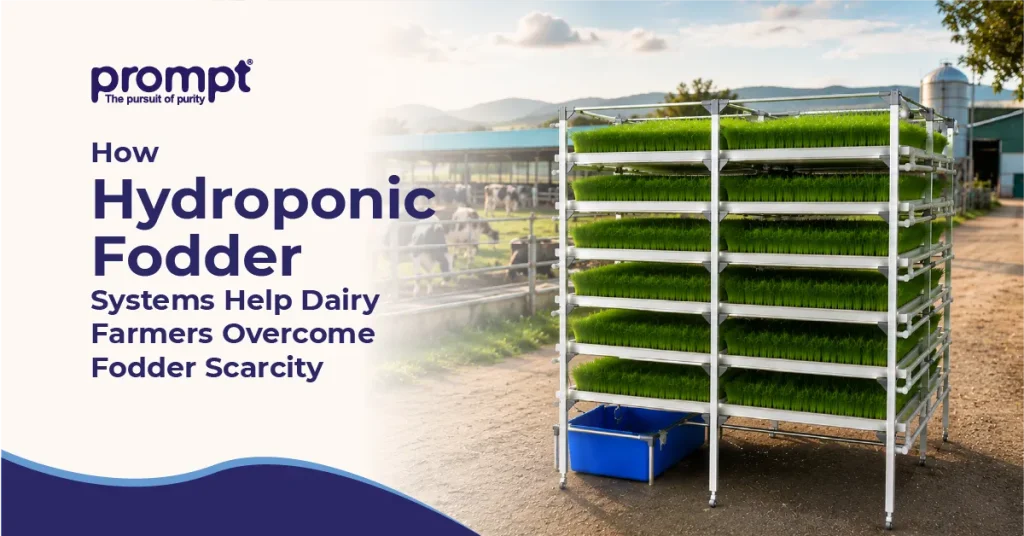
A hydroponic fodder system grows green fodder without soil by using water and controlled growing conditions. Seeds such as maize, wheat, or barley are sprouted in specially designed channels where they receive continuous moisture and nutrients. Within 7–8 days, the system produces fresh green fodder that can be fed directly to cattle.
Unlike conventional fodder cultivation, hydroponic systems can be installed in as little as 10 ft × 10 ft of space, use 80–90% less water, and are not affected by seasonal weather conditions.
How Hydroponic Fodder Supports Dairy Farming
The biggest advantage of hydroponic fodder is consistency. Instead of depending on seasonal fodder availability, dairy farmers can produce fresh fodder every day.
Fresh hydroponic fodder improves feed digestibility and provides better nutrition, helping maintain cattle health and productivity. Studies and field experience have shown improvements in milk yield, milk fat, and overall cattle performance.
For dairy farmers, a regular supply of fresh green fodder helps maintain better cattle nutrition, supporting more consistent milk production and improved herd performance throughout the year.
Water-Smart Fodder Production
Water availability is becoming a major concern in dairy farming. Traditional fodder cultivation requires large quantities of water, making it difficult in drought-prone regions.
Hydroponic fodder systems address this challenge by recirculating water during the growing process. Prompt FodderEasy, based on Nutrient Film Technique (NFT), uses only 2–3 litres of water to produce one kilogram of fodder, saving 80–90% water compared to conventional fodder cultivation. The naturally ventilated design also eliminates the need for energy-intensive climate-controlled chambers, making it suitable for Indian farming conditions.
How Prompt FodderEasy Helps Dairy Farmers
Prompt FodderEasy is based on Nutrient Film Technique (NFT), which ensures uniform water distribution across the growing channels, helping produce consistent, high-quality green fodder while using significantly less water than conventional cultivation. A compact unit can be installed in approximately 10*10. ft. and can produce 45–60 kg of green fodder can producing on a low-power 80 W pump that is also solar compatible.
The system is designed to reduce dependence on external fodder suppliers while lowering feed costs and improving cattle nutrition. Because it requires only around 1–1.5 hours of daily operation, it is easy to manage for both small dairy farmers and larger dairy enterprises.
Building a More Sustainable Dairy Industry
As milk production continues to grow, ensuring a reliable supply of quality fodder is becoming increasingly important for dairy farmers. Technologies such as hydroponic fodder help farmers produce fresh green fodder throughout the year while reducing dependence on seasonal cultivation and conserving valuable water resources.
Hydroponic fodder systems provide a practical way to address fodder shortages, reduce water consumption, improve cattle nutrition, and support sustainable dairy farming. By adopting technologies such as Prompt FodderEasy, dairy farmers can improve fodder security, reduce dependence on seasonal cultivation, strengthen cattle nutrition, and build more sustainable dairy farms.
Conclusion
As water, land, and feed resources become increasingly limited, hydroponic fodder offers dairy farmers a practical way to ensure year-round availability of fresh green fodder. Prompt FodderEasy combines NFT technology with a simple, farmer-friendly design to help improve cattle nutrition, support healthier herds, and build a more productive and sustainable dairy farm.
Frequently Asked Questions
1. What is a hydroponic fodder system?
A hydroponic fodder system grows green fodder without soil using water and controlled growing conditions. Fresh fodder is ready in about 7–8 days.
2. How does hydroponic fodder benefit dairy farmers?
It provides a year-round supply of fresh green fodder, reduces dependence on seasonal cultivation, saves water, and supports better cattle nutrition.
3. How much water does a hydroponic fodder system use?
NFT-based systems like Prompt FodderEasy use only 2–3 litres of water per kilogram of fodder, saving up to 80–95% water compared to conventional cultivation.
4. Can hydroponic fodder improve milk production?
When used as part of a balanced feeding programme, hydroponic fodder can help improve cattle nutrition, supporting better milk yield and milk quality.
5. Who can use Prompt FodderEasy?
Prompt FodderEasy is suitable for progressive dairy farmers, commercial dairy farms, breeding centres and gaushalas looking to produce fresh green fodder throughout the year.