Small dairy farms are the backbone of India’s dairy industry. However, producing enough fresh green fodder throughout the year is becoming increasingly difficult due to limited land, water scarcity, rising feed costs, and unpredictable weather. As a result, many farmers are looking for practical alternatives that can help maintain cattle nutrition without increasing production costs.
Many farmers depend on dry fodder or purchased green fodder, but its availability and quality often change with the season. This can affect cattle nutrition, milk production, and overall farm profitability.
Hydroponic fodder systems are becoming a practical solution for small dairy farms by enabling farmers to grow fresh green fodder throughout the year using less land and water. But is it the right choice for every small dairy farm?
Challenges Faced by Small Dairy Farms
Unlike large commercial dairy farms, small dairy farmers often have limited resources for fodder cultivation. Setting aside land exclusively for growing fodder is not always possible, especially when land is also required for food crops or other farming activities.
Seasonal rainfall, increasing irrigation costs, and labour availability add to these challenges. During periods of fodder shortage, farmers often have to purchase green fodder from the market, increasing the cost of feeding dairy cattle.
Maintaining a regular supply of fresh green fodder throughout the year therefore becomes a major concern for many small dairy farms.
How Hydroponic Fodder Can Help
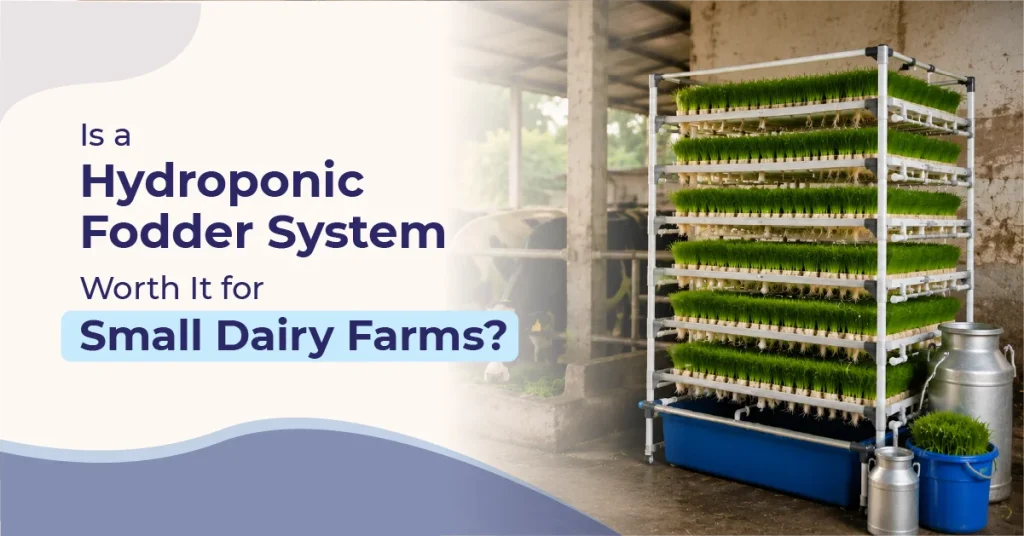
A hydroponic fodder system grows fresh green fodder without soil in a controlled environment. Crops such as maize, wheat, or barley are germinated using water and are ready for harvesting within 7–8 days.
Unlike conventional fodder cultivation, hydroponic systems require very little space and use significantly less water. Since fodder is produced in a controlled environment, farmers can continue production throughout the year without depending on seasonal weather conditions.
This gives small dairy farmers access to a consistent supply of fresh green fodder, even when conventional fodder is not easily available.
Is It Worth the Investment?
For most dairy farmers, the biggest question is not whether hydroponic fodder works—it is whether the investment delivers long-term value. When feed accounts for nearly 72–75% of the total cost of milk production, improving fodder availability and feed efficiency can significantly reduce operating costs and improve farm profitability.
A hydroponic fodder system can be a worthwhile investment for dairy farms that want to:
- Reduce feed costs, which account for nearly 72–75% of the total cost of milk production.
- Produce fresh green fodder in just 7–8 days, compared to 45–60 days with conventional fodder cultivation.
- Harvest fodder throughout the year with up to 50 growing cycles annually.
- Produce 7–8 kg of fresh green fodder from every 1 kg of seed.
- Reduce water consumption by 80–90%, using only 3–4 litres of water per kg of fodder.
- Grow fresh fodder in a compact area of just 100–250 sq. ft., making it suitable for farms with limited land.
- Lower fodder production costs to approximately ₹3–6 per kg, depending on seed cost and operating conditions.
- Reduce overall feed costs by 30–50% through improved feeding efficiency.
- Spend only 1–1.5 hours per day operating and maintaining the system.
- Support better cattle nutrition, which can contribute to 10–25% improvement in milk production
How Prompt Fodder Easy Supports Small Dairy Farms
Prompt Fodder Easy is an NFT-based hydroponic fodder system designed to make green fodder production simple and practical for dairy farmers. It produces fresh green fodder within 7–8 days while using significantly less water and space than conventional fodder cultivation.
Its naturally ventilated design, compact footprint, and low power consumption make it suitable for small dairy farms. The system is easy to operate and enables farmers to produce fresh green fodder throughout the year without depending on changing weather conditions.
By improving fodder availability, Prompt Fodder Easy helps farmers provide better nutrition to their cattle and maintain more consistent milk production.
Conclusion
For dairy farmers looking to reduce feed costs, overcome seasonal fodder shortages, and improve cattle nutrition, a hydroponic fodder system is more than just another farming technology—it is a practical investment in the long-term productivity and sustainability of the dairy farm. Prompt Fodder Easy makes this transition simple, reliable, and farmer friendly.
While hydroponic fodder is not a replacement for a balanced feeding programme, it is an effective way to improve fodder availability and support better cattle nutrition. Solutions such as Prompt Fodder Easy help small dairy farms adopt a more reliable and sustainable approach to fodder production, supporting healthier cattle and more consistent milk production.
Frequently Asked Questions
1. Is a hydroponic fodder system suitable for small dairy farms?
Yes. Hydroponic fodder systems are ideal for small dairy farms that have limited land, face water shortages, or want to produce fresh green fodder throughout the year.
2. How long does it take to grow hydroponic fodder?
Hydroponic fodder is typically ready for harvesting within 7–8 days, depending on the crop and growing conditions.
3. Does hydroponic fodder require a lot of land?
No. Hydroponic fodder systems have a compact design and require much less space than conventional fodder cultivation.
4. Can hydroponic fodder replace traditional green fodder?
No. Hydroponic fodder is best used as part of a balanced feeding programme along with dry fodder, silage, and concentrate feed.
5. Why is Prompt Fodder Easy suitable for small dairy farms?
Prompt Fodder Easy helps small dairy farms produce fresh green fodder throughout the year using less land and water. Its compact design, simple operation, and low power consumption make it a practical solution for improving fodder availability and cattle nutrition.